
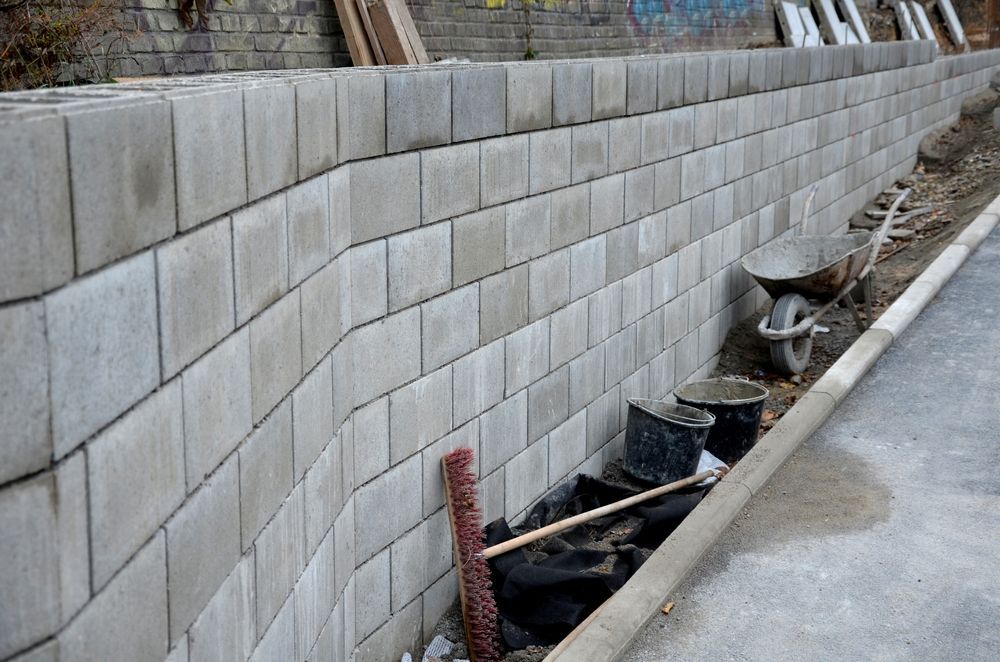
Structural Solutions That Hold Soil and Manage Water
Retaining Wall Construction in Sidney for properties where erosion, slope failure, and runoff threaten landscaping and structures
Finish Line Concrete designs and builds retaining walls for residential and commercial properties in Sidney and the surrounding areas, using reinforced concrete systems engineered to manage elevation changes, prevent soil erosion, and redirect water away from foundations and paved surfaces. When your property shows signs of slope movement, gullying, or undermined landscaping, a properly constructed retaining wall stabilizes the grade and protects the investment you've made in buildings and outdoor improvements.
The construction process begins with excavation and base preparation, followed by forming and placement of rebar or other reinforcement to handle lateral soil pressure and freeze-thaw movement. Concrete is poured in lifts or as a continuous pour depending on wall height, then finished with attention to drainage provisions that prevent hydrostatic pressure buildup behind the wall. Weep holes, gravel backfill, and drainage tile are integrated where needed to manage groundwater and surface runoff.
If your property has grade issues that affect usability, drainage, or stability, reach out to discuss retaining wall options and site-specific design considerations.
What a Retaining Wall Does for Your Property
Your retaining wall creates a stable vertical or near-vertical face that holds soil in place, allowing you to use sloped areas for landscaping, parking, or building sites that would otherwise erode or require constant regrading. Finish Line Concrete accounts for soil type, drainage patterns, and wall height when determining reinforcement spacing, footing depth, and backfill requirements, so the wall remains stable through seasonal moisture changes and freeze-thaw cycles.
Once the wall is complete, you'll see a defined boundary that controls water flow, reduces sediment runoff into driveways or buildings, and supports level planting beds or walkways on the uphill side. The wall face can be left smooth, textured, or formed with decorative patterns depending on your site's aesthetic and functional needs.
Drainage features behind the wall ensure that water doesn't accumulate and exert pressure that could crack or shift the structure over time. Walls taller than four feet typically require engineered designs that specify reinforcement details, footing dimensions, and tie-back systems if necessary. Shorter walls often use gravity-based designs that rely on mass and proper backfill to resist soil loads. Expansion joints are included in longer walls to allow movement without cracking, and control joints manage shrinkage during the curing process.
Retaining Wall Design and Construction Questions
Homeowners and property managers often ask about wall height limits, drainage methods, and how soil conditions affect the design.
What determines how deep the footing needs to be?
Footing depth depends on wall height, soil bearing capacity, and frost line—taller walls and weaker soils require deeper footings to distribute loads and resist frost heave.
How does water management affect wall longevity?
Walls without adequate drainage experience hydrostatic pressure that cracks the concrete or shifts the entire structure, so gravel backfill and weep holes are critical to long-term performance.
Why do some retaining walls lean or crack within a few years?
Insufficient reinforcement, poor compaction of backfill, or inadequate drainage allow soil pressure and water weight to exceed the wall's structural capacity.
When should you tie a retaining wall into the slope behind it?
Taller walls or walls holding unstable soil may require tie-backs or anchors that extend into the slope and distribute loads deeper into stable soil layers.
How do Sidney soil conditions affect retaining wall design?
Clay-heavy soils expand when wet and contract when dry, creating additional lateral pressure that must be accounted for in reinforcement and drainage planning.
Finish Line Concrete evaluates your site's topography, soil composition, and drainage patterns to design retaining walls that perform reliably over the long term. Contact the team to schedule a consultation and get a project estimate based on wall length, height, and site conditions.